


In the far northeastern corner of Cao Bang Province, where limestone mountains rise above a patchwork of rice fields and scattered villages, Ngoc Con Valley offers a rare escape from the crowds that have come to define many of Vietnam’s better-known destinations. Shaped by karst peaks and traced by the slow curves of the Quay Son River, it presents a calmer and more intimate side of the north, one in which daily life still follows the rhythm of the harvest and the seasons rather than the pace of tourism.
The valley is best appreciated slowly, through a climb to its panoramic viewpoint, an unhurried ride along country lanes, and conversations with the Tay and Nung families who have farmed this land for generations. This guide follows the same order that most travelers will find useful, beginning with where the valley lies and when it looks its best, then moving on to what to see and do, how to arrive, where to sleep, and how to prepare.
Table of Contents
Where is Ngoc Con valley and what makes it special?
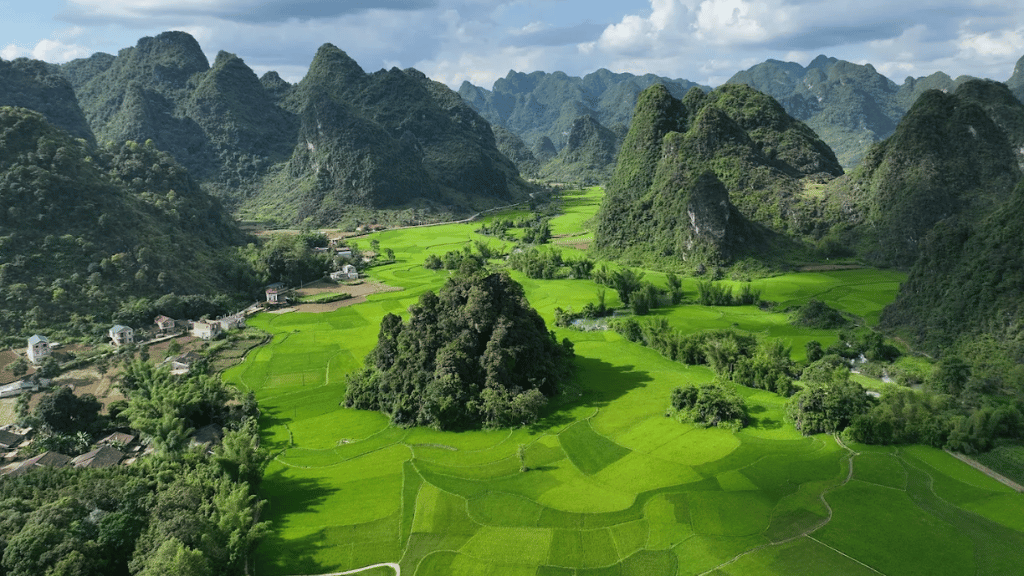
Ngoc Con lies in the northeastern part of Cao Bang Province, close to the Chinese border, in a setting of karst ridges and cultivated fields that feels remote yet remains within easy reach of the region’s main attractions. The Quay Son River enters Vietnam through this area before flowing across Trung Khanh District on its way to the celebrated Ban Gioc Waterfall, which places the valley at the very beginning of one of the most famous river journeys in the country, and from the center of Trung Khanh it takes a little over 20 kilometers along Provincial Road 213, which crosses the former commune and continues to the Po Peo border gate, to reach it.
What makes Ngoc Con special is first of all the character of its landscape, because, unlike the terraced hillsides that most travelers associate with Vietnam’s Northwest, its paddies spread across the valley floor and follow the course of the river, creating a scene closer to the rice-growing plains of Southeast Asia than to the postcard views of Sapa, with limestone mountains rising directly from the fields and colors that shift from the greens and yellows of spring to the gold of the autumn harvest. Just as importantly, the valley remains largely untouched by mass tourism and is still a working rural territory where Tay and Nung communities live among their fields, so that a slow walk between paddies or a conversation with a local family matters more here than any single sight, and this gentle atmosphere finds its natural culmination at Pi Pha Viewpoint, from which the river, the rice fields, the villages and the mountains can be seen together in one sweeping panorama.
When is the best time to visit Ngoc Con?
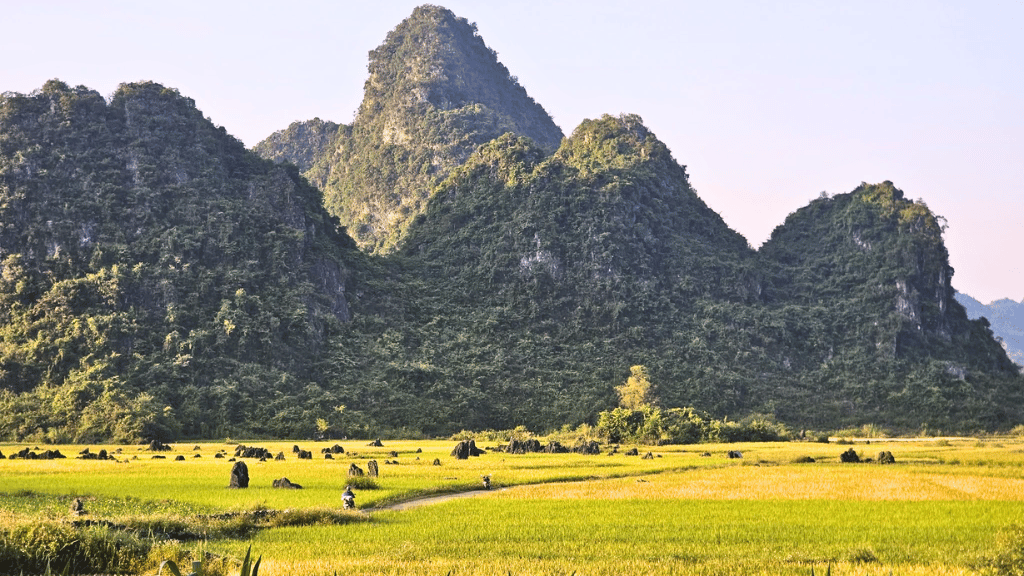
Because the valley changes color with the agricultural calendar, the best moment to visit depends on the kind of scenery you hope to find, and each season offers something different.
In late April and early May, the valley fills with plots of corn, tobacco and other crops, weaving together layers of green and yellow that soften the gray of the surrounding cliffs. By June, residents begin to bring in the first harvests and to prepare their land for the next rice season, so the landscape shifts gradually from one palette to another as the work of the fields moves forward.
For many travelers, autumn is the most rewarding time to come, since the rice reaches maturity in these months and the fields turn a warm gold that contrasts beautifully with the limestone reliefs and the waters of the Quay Son. Exact dates vary from year to year depending on the weather and the local farming calendar, so it is wise to check the condition of the fields shortly before you leave if seeing them at their peak is your priority.
What to see and do in Ngoc Con Valley
The experience here rests on two complementary perspectives: a high viewpoint that reveals the valley as a whole, and the valley itself, which is best discovered step by step along the river and through its villages. Starting from above and then descending into the landscape is a natural way to explore both.
Climb to Pi Pha Viewpoint for the full panorama
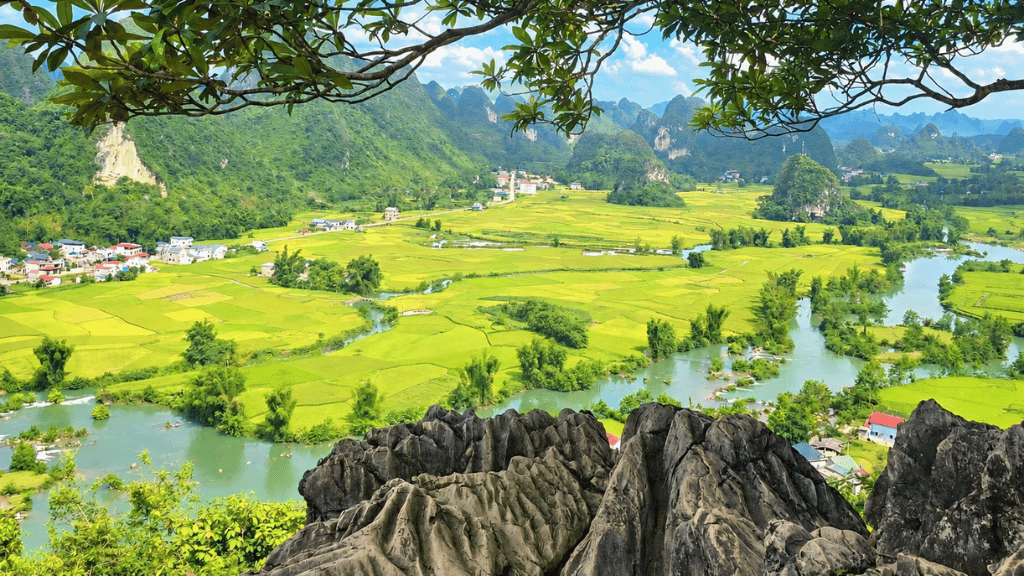
Pi Pha Viewpoint, also known as Ngoc Con Panorama, has become the valley’s main point of interest, and its elevated position allows visitors to take in the rice fields, the villages and the winding Quay Son in a single sweeping view. Reaching it requires an uphill walk along a natural trail, which takes roughly 30 to 45 minutes depending on your pace and route according to travelers and local sources, and the ground can turn slippery after rain, so sturdy shoes are essential and the climb is best avoided just after heavy showers.
The effort pays off above all through the change in perspective it provides. From the valley paths it is the mountains that dominate the scenery, whereas from the summit the river appears as a long ribbon across the cultivated land, the paddies spread in broad plots at the foot of the limestone, and small Tay and Nung hamlets settle into the countryside with houses scattered between fields and country roads. While the rice is growing, the whole scene glows in shades of green against the gray cliffs, and in September and October the same plots turn gold as the harvest approaches, making this the point from which the succession of mountains, rice fields, villages and river bends that defines Ngoc Con is easiest to understand.
Follow the Quay Son River through the valley
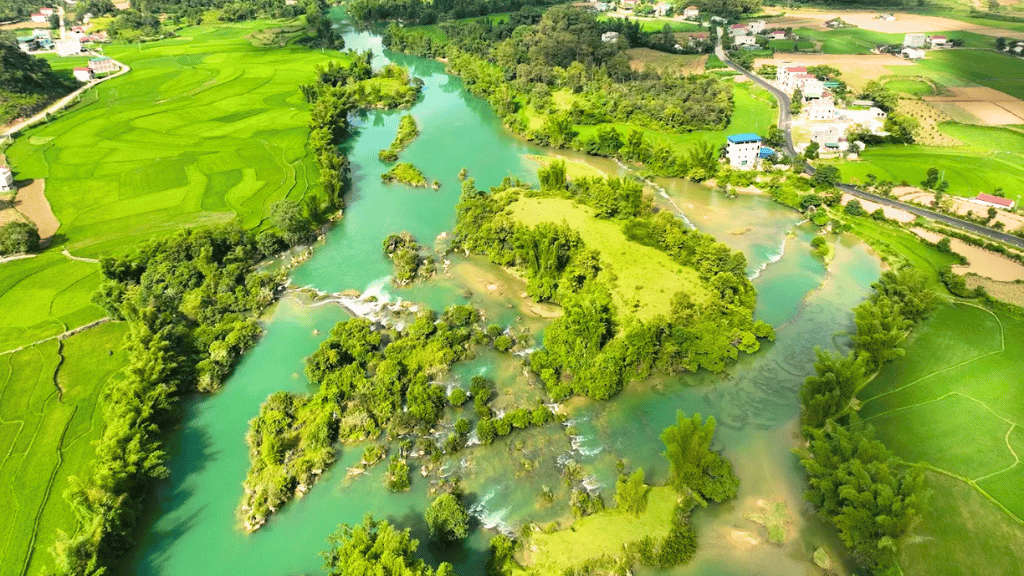
Once you have seen the valley from above, the Quay Son River offers a natural thread to follow on the ground, since it accompanies the landscape at every turn. The river begins its journey in China, enters Vietnam through this region, crosses several communes of Cao Bang and eventually feeds Ban Gioc Waterfall, and in Ngoc Con its waters meander between rice fields, villages and limestone reliefs. Following the small roads that run alongside it, whether on foot, by bicycle or by motorbike, reveals the valley’s different faces one after another, from cultivated fields to everyday scenes of rural life. After heavy rains the current can grow stronger, so it is best to keep a safe distance from the water and to follow local safety advice.
Wander through the rice fields and villages
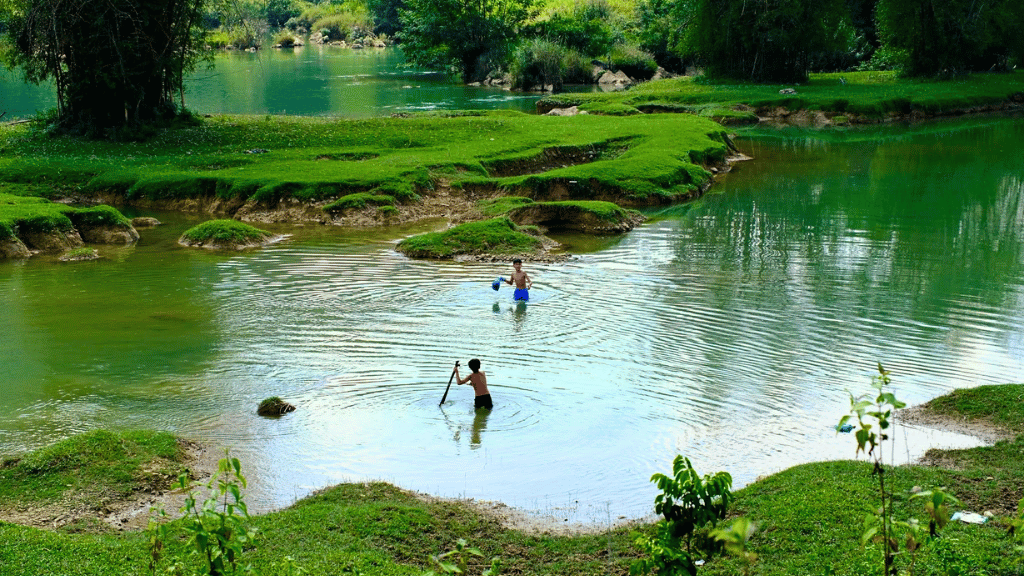
There is no need to rush between attractions in Ngoc Con, because a simple walk along the valley’s small roads already brings the rice fields, traditional houses, domestic animals and daily farming activities into view. During the harvest, visitors may see residents working in the paddies and carrying rice back to their villages, and the valley is also home to Nep Ong, a traditional sticky rice variety from Trung Khanh that is grown in several communes along the Quay Son, Ngoc Con among them. When passing through a village, a discreet and respectful attitude goes a long way, and it is always polite to ask permission before photographing local people.
Cycle the quiet lanes at your own pace
For those who prefer to move more freely, cycling is an excellent way to explore the most accessible parts of the valley, since the small roads make it easy to stop whenever a view or a scene catches your attention, without the constraints of a motorized vehicle. The real pleasure lies in the slowness of the journey, as only a few kilometers can take you from a stretch of rice fields to a village and then to a viewpoint over the river, although for a longer ride it is sensible to ask your accommodation about the condition of the paths before setting out.
Meet the Tay and Nung communities
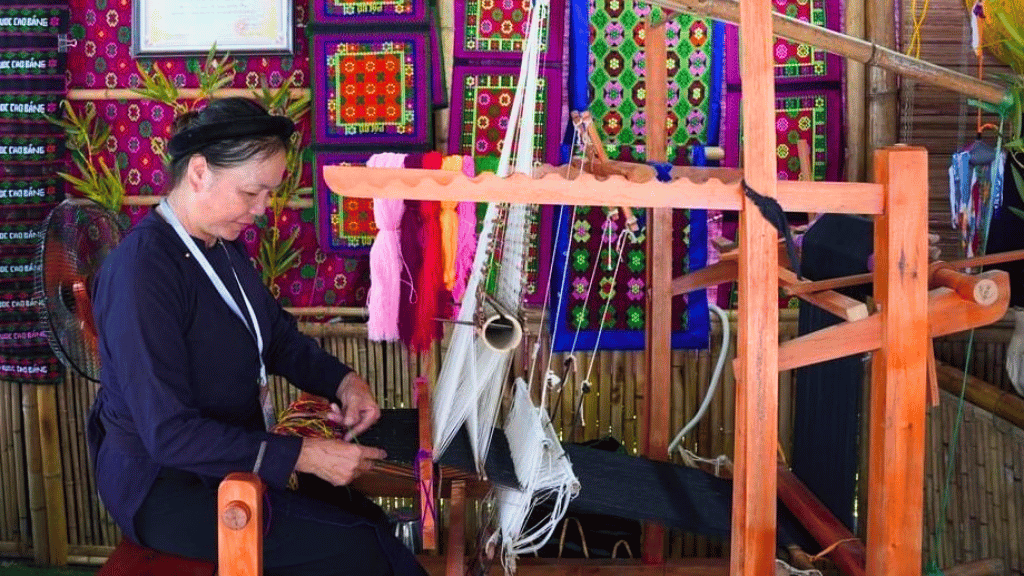
Behind the scenery, Ngoc Con is above all a living rural territory, home to Tay and Nung communities whose economy has long revolved around agriculture and the activities that surround the local waterways. Staying with a local family, sharing a meal or simply talking with residents offers a glimpse of another side of Cao Bang, far from its busiest sites, and the experience is all the richer when it stays simple, with visitors observing, chatting, tasting local products and taking the time to understand village life rather than seeking entertainment designed for tourists.
Taste the flavors of Trung Khanh and Cao Bang
Meals are part of that encounter with local life, though Ngoc Con itself has few restaurants, which makes it easiest to arrange your meals with your accommodation or to travel to Trung Khanh, where the choice is wider. Among the region’s emblematic products are Nep Ong sticky rice, freshwater river fish and the specialties of Trung Khanh, and autumn visitors should look out for the Trung Khanh chestnuts, which are harvested in September and October and have held a protected geographical indication since 2011. Across Cao Bang more broadly, it is also worth seeking out banh cuon, the steamed rice rolls of the north, and vit quay 7 vi, a roast duck seasoned with seven flavors, along with other dishes prepared from local ingredients.
How to get to Ngoc Con Valley
Reaching the valley takes some planning, because Ngoc Con cannot be reached directly from Hanoi and the route necessarily passes through Cao Bang and then Trung Khanh before the final kilometers. The best way to approach the journey therefore depends on where you begin.
From Hanoi
The simplest plan is to travel first to Cao Bang and then continue toward Trung Khanh and Ngoc Con. Hanoi and Cao Bang are separated by about 280 kilometers by road, and buses and minibuses generally take between 6 and 8 hours depending on the service and traffic, while there is no railway connection to Cao Bang. From there, it is about 80 kilometers to Trung Khanh and roughly 20 more to Ngoc Con, and for a leisurely trip a private car with a driver is particularly convenient, especially if you want to combine several stops in the region without worrying about mountain driving.
From Ha Giang and other cities
Travelers coming from Ha Giang can weave Ngoc Con into an itinerary linking Ha Giang and Cao Bang, a road journey that can take a full day depending on the route, and those who continue the loop through Bao Lac can combine the landscapes of both provinces in a single trip. From Ho Chi Minh City, Da Nang and other large cities in the center and south, it is generally more practical to fly to Hanoi and continue by road toward Cao Bang.
Getting around once you arrive
Public transport within the valley is limited, so most visitors rely on a motorbike if they are comfortable on mountain roads, a bicycle for exploring the small lanes at an easy pace, or a car with a driver, which suits families and itineraries that combine several sites. Whichever you choose, keep in mind that part of the route to Pi Pha Viewpoint must always be covered on foot.
Where to stay near Ngoc Con Valley
Accommodation around the valley remains fairly simple, consisting mainly of homestays, guesthouses and small family-run hotels, so the right choice depends on the kind of experience you want and how close you wish to be to the region’s other sites.
Homestays in the valley for rural immersion
Within the valley itself, homestays are the best option for travelers who want to immerse themselves in the rural setting, with rooms typically arranged in local houses alongside simple shared spaces and a family atmosphere. Some hosts also serve meals, which lets guests taste home-cooked food and gain an easier window into daily life.
Guesthouses in Trung Khanh for added comfort
In Trung Khanh the choice is wider, with family-run guesthouses that generally offer private rooms with bathrooms, which makes this a good solution for those who want a little more comfort while remaining close to Ngoc Con and the main sights of the region.
Small hotels near Ban Gioc for combined itineraries
Around Ban Gioc Waterfall, travelers will also find small hotels and lodges with private rooms and a broader range of services, a practical base for pairing Ngoc Con with Ban Gioc and the other attractions of Trung Khanh District.
Tips for a safe and enjoyable visit to Ngoc Con Valley
- Wear shoes with good grip: Choose comfortable, sturdy footwear if you plan to hike to Pi Pha Viewpoint, as some sections of the trail can be uneven or slippery.
- Start your hike early: Set off in the morning so there is enough daylight to complete the hike and return safely before nightfall.
- Check the weather forecast: Heavy rain can make trails and roads slippery and may increase the risk of landslides, so consider postponing hikes in poor weather.
- Download an offline map: Some secondary roads and trails around the valley are poorly signposted. An offline map can be particularly useful when exploring independently.
- Carry some cash: Cash is useful for meals, small local services and purchases from residents, especially away from the main tourist areas.
- Respect private land and local life: Do not walk through rice fields or private property without permission, even if the path looks accessible.
- Ask before taking photographs: Always ask for permission before photographing local residents, particularly when capturing people at work or inside their homes.
- Allow enough time for nearby sites: If combining Ngoc Con with other attractions around Cao Bang, set aside at least a full day to avoid spending most of the day travelling between stops.
FAQ
1. How much does a trip to Ngoc Con valley cost?
A budget of around $100 per day is generally enough for a comfortable trip to Ngoc Con Valley, including accommodation, meals, local transport and some activities. The total cost may vary depending on the type of accommodation and transport chosen
2. How long does it take to explore Ngoc Con valley?
Two to three days are enough to explore Ngoc Con Valley at a comfortable pace, with time for walks through the rice fields, a hike to Pi Pha Viewpoint and visits to nearby villages and attractions
3. What other attractions can be visited near Ngoc Con valley?
Ngoc Con Valley can easily be combined with Ban Gioc Waterfall and Nguom Ngao Cave. The Quay Son River and the surrounding villages also offer opportunities to discover the landscapes and local way of life in the Trung Khanh area
4. What is the best viewpoint in Ngoc Con Valley?
Pi Pha Viewpoint is one of the highlights of Ngoc Con Valley. From the summit, visitors can enjoy a panoramic view of the Quay Son River, rice fields, villages and limestone mountains surrounding the valley
5. Is Ngoc Con Valley suitable for a family trip?
Ngoc Con Valley is suitable for families, particularly for easy walks around the rice fields and villages. However, the trail to Pi Pha Viewpoint includes uneven and sometimes steep sections, so young children may need extra assistance
Still little visited by mainstream tours, Ngoc Con Valley offers a more personal introduction to northern Cao Bang, where limestone mountains, rice fields, the Quay Son River and small villages come together in a landscape that changes with the seasons and invites a slower kind of travel. For those who take the time to follow its paths and climb to Pi Pha, the reward is a glimpse of rural Vietnam that feels authentic and peaceful, and that tends to linger in the memory long after the journey has ended.
Would you like to discover Ngoc Con and the landscapes of Northeast Vietnam? Browse our travel ideas or contact the local experts at Hanoi Voyages to create a tailor-made itinerary that suits your pace and your interests.




 Google
  Facebook
  Tripadvisor
  Trustindex


