


Damnoen Saduak Floating Market is one of the most photographed sites in Thailand — and one of the most popular day trips from Bangkok. Located roughly 80 km from the capital, this waterway market plunges you into a world suspended in time: dozens of colorful wooden boats loaded with tropical fruits, steaming street food, and handcrafted souvenirs weave through narrow canals in the Chao Phraya delta every morning.
But what is it actually like? Is it too touristy? Which boat ticket should you choose? How do you avoid the common pitfalls? This complete guide covers everything you need before you go — hours, prices, how to get there from Bangkok, and insider tips for an authentic visit.
Table of Contents
Historical overview of Damnoen Saduak Floating Market
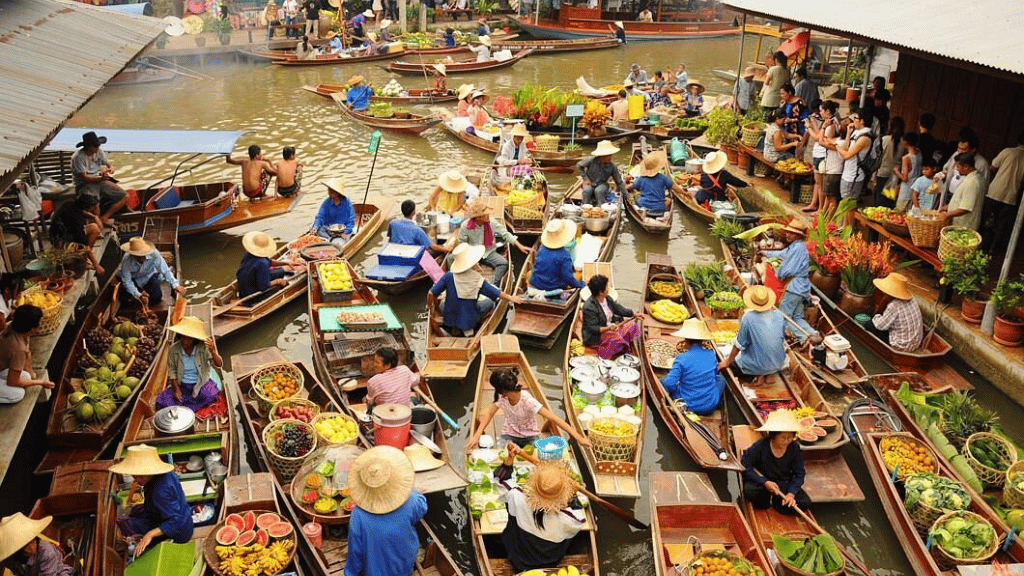
Damnoen Saduak Floating Market sits along a historic canal built in the 19th century to link the Mae Klong and Tha Chin rivers. This 32-kilometre waterway, dug entirely by hand, remains a central feature of local life in the region today.
The market originally formed in the Khlong Lat Phli area, where local vendors’ boats created a lively, organic scene. Over time it has oriented more toward tourism but it still offers a genuine window into the atmosphere of traditional Thai floating markets.
During your visit, you’ll see vendors offering tropical fruits and local produce directly from their boats. While part of the market has evolved to accommodate visitors, it retains a unique charm and remains a must-see experience within easy reach of Bangkok.
🎬 Film trivia: The 1974 James Bond film The Man with the Golden Gun was partially filmed on these very canals. If you want to find the angle from the boat chase scene, position yourself on the central bridge, on the west side.
Practical info: Hours, prices & getting there
Before heading to Damnoen Saduak, knowing the real-world logistics makes all the difference. Here’s what you actually need to know – not just the official version.
Opening hours
| Time Window | What’s actually happening |
|---|---|
| 6:00 – 7:00 AM | Local vendors are setting up and eating their own breakfast on their boats – this is the most authentic moment, and almost completely unknown to tourists. |
| 7:00 – 8:30 AM | Best window. The market is fully alive, boats are plentiful, atmosphere is calm. Golden hour for photos. |
| 8:30 – 9:30 AM | First tour coaches arrive. Still manageable and enjoyable. |
| 9:30 – 11:00 AM | Canal traffic jams, prices creep up, vendors focus on volume over interaction. |
| After 11:00 AM | Half the vendors have packed up. What remains is mostly roadside souvenir fare. |
Note: The liveliest part of the day runs roughly 8:30 AM to 1:00 PM. On weekends (Saturday and Sunday), the market stays open a little longer – up to around 2:00 PM.
Boat tour prices
Several boat options are available at Damnoen Saduak, letting you explore the canals at your own pace. You can also check the official market website for the latest rates and boarding points.
| oat Type | Capacity | Duration | Price (per boat) |
|---|---|---|---|
| Traditional rowing boat | 1–5 people | 30 minutes | 400 THB (~11 USD) |
| Traditional rowing boat | 1–5 people | 1 hour | 500 THB (~14 USD) |
| Motorboat | 1–6 people | 1 hour | 850 THB (~24 USD) |
| Motorboat | 1–6 people | 1.5 hours | 1,200 THB (~34 USD) |
Our recommendation: Go for the traditional rowing boat. It’s slower, sits lower on the water, and lets you take your time observing local life, chatting with vendors, and soaking up the atmosphere. Motorboats cover more ground but the engine noise and speed make the experience feel more like a commute than an immersion.
How to get to Damnoen Saduak from Bangkok
- Public Minivan: Minivans depart from Sai Tai Mai Bus Terminal in southern Bangkok, every 40 minutes from 6:30 AM. The ride takes roughly 1 hour 40 minutes, and the minivan drops you about 1 km from the market a 10-minute walk or 10–20 THB motorbike taxi ride away
- Private Taxi or Grab: Ideal for small groups or travellers who want maximum flexibility. Ask the driver to drop you directly at the market entrance – not at an intermediate pier – to avoid being walked into an overpriced boat booking scheme
- Organised day tour: The most hassle-free option for first-time visitors. Most tours include air-conditioned transport, an English-speaking guide, a boat ride, and often a stop at Maeklong Railway Market. No negotiating, no logistics headaches – everything is arranged for you.
What you can see and do at Damnoen Saduak Floating Market
Damnoen Saduak isn’t just a few photos from a boat. From the moment you arrive, you’re dropped into a living scene where the canals themselves are the main arteries of activity – vendors on the water, the aroma of Thai cooking, quick-fire transactions, and glimpses of everyday life, offering a true travel Thailand experience.
What you actually experience depends heavily on when you arrive and how you explore. Between the touristy stretches and the quieter, more authentic corners, the market can feel like two different places and that’s precisely what makes it interesting.
Navigating the canal network
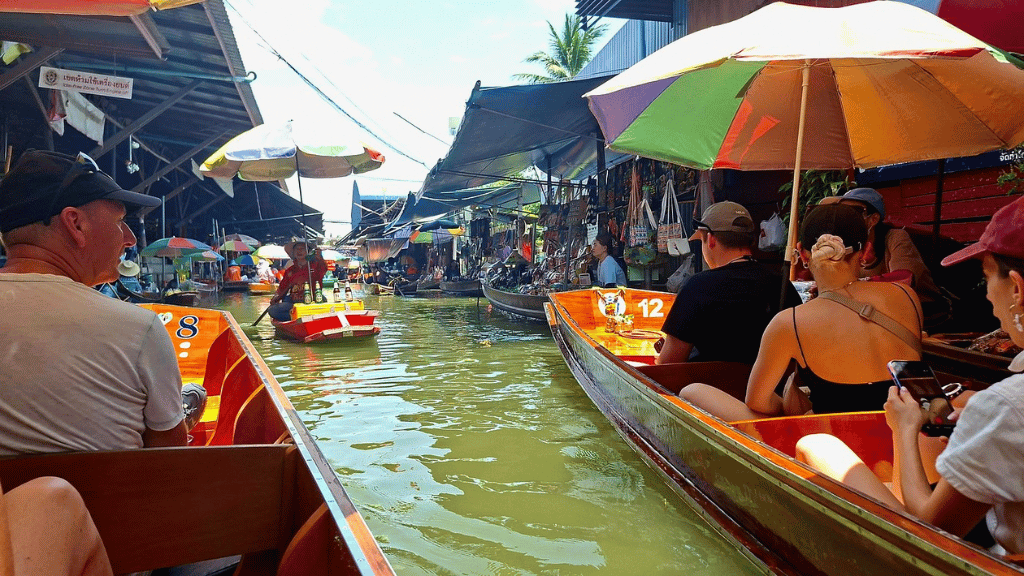
Most visits start with a short motorboat transfer, after which you transfer to a small rowing boat to enter the narrower waterways. That’s where the market truly comes to life.
Boats pass within centimetres of each other. Vendors many in traditional wide-brimmed hats extend their goods directly over the water toward you: perfectly ripe sliced mangoes, chunks of pineapple, small floating kitchens where boat noodles bubble away on gas burners. The best moments arrive early in the morning, before tour groups flood in.
Understanding what you’re buying
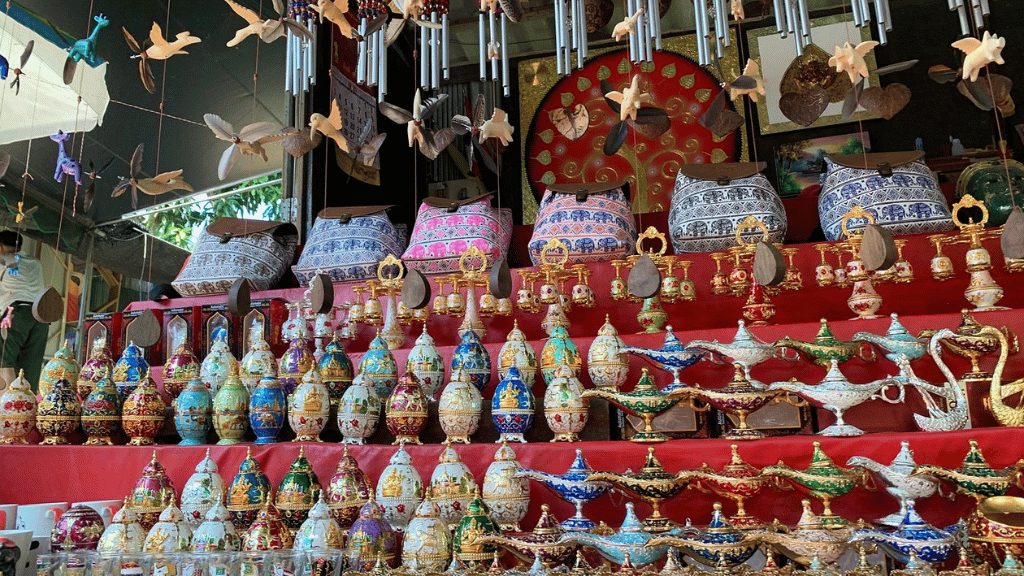
Most stalls along the main canals are clearly oriented toward visitors. You’ll find plenty of classic Thai souvenirs – elephant-print trousers, herbal soaps, wooden carvings, neatly packaged spices. Look a little closer, though and you’ll notice that fresh fruit often comes directly from nearby orchards and farms, while other goods have filtered through more conventional supply chains.
Eating directly from a boat
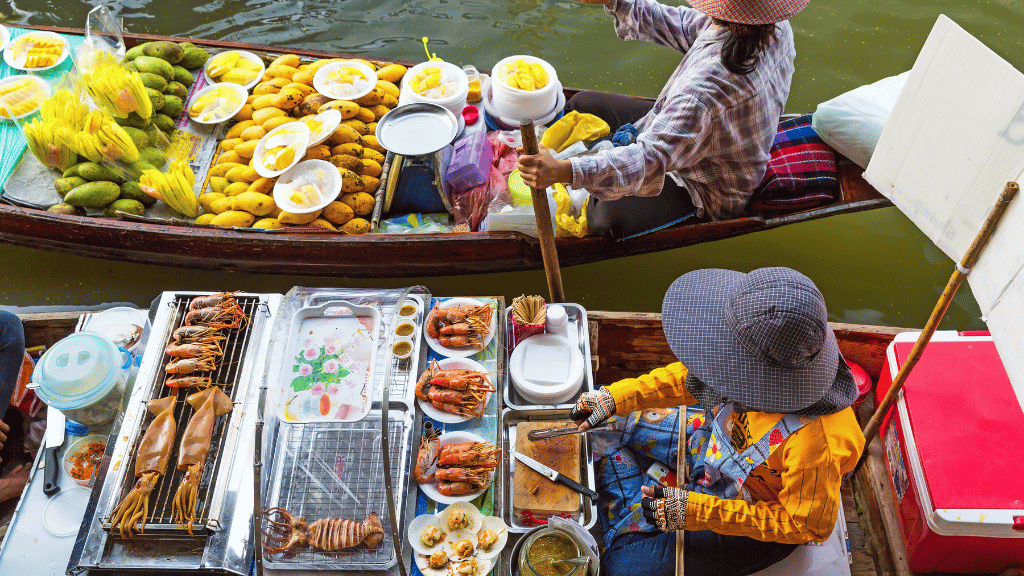
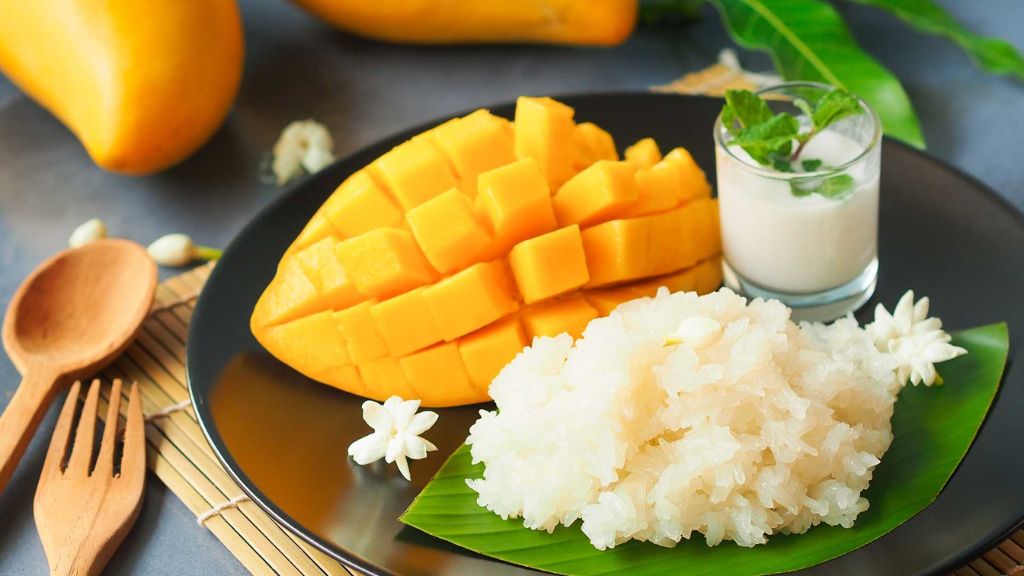
One of the most distinctive pleasures of a floating market is eating without ever stepping off your boat. Vendors drift alongside, present their dishes, and serve you on the spot a spontaneous, unhurried ritual that perfectly captures the spirit of Thai cuisine
- Boat Noodles (Kuai tiao rua) – 30–50 THB per bowl: Rich, dark broth served directly from the boat. A century-old recipe that has barely changed and shouldn’t.
- Mango Sticky Rice (Khao Niew Mamuang) – 60–80 THB: The quintessential Thai dessert. Glutinous rice in coconut milk with fresh mango exactly as good as its reputation.
- Bamboo Sticky Rice (Khao Lam) – 20–40 THB: Glutinous rice cooked inside bamboo with palm sugar. Under-the-radar and exceptional.
- Thai Crispy Crepes (Khanom Buang) – 30–50 THB: Ultra-crispy folded crepes filled with coconut cream. Hard to find elsewhere; this is the place to try them.
- Salt-Crusted Grilled Fish (Pla Pao) – 80–120 THB: Whole fish grilled with a thick salt crust, cooked on the boat right in front of you. Smoky, tender, unforgettable.
- Coconut Ice Cream (I-tim Kati) – 40–60 THB: Served in a halved coconut shell with roasted peanuts. The perfect relief from the midday heat.
Wandering away from the main canals
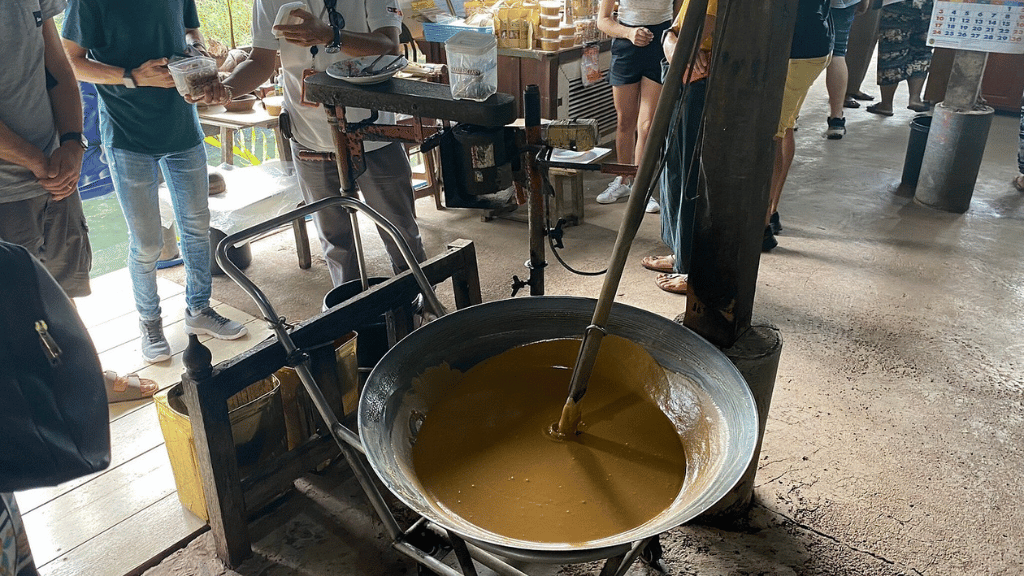
As soon as you leave the busiest waterways, the atmosphere shifts. The noise of engines fades, and you find yourself in a calmer stretch wooden houses on stilts, some clearly old, with open terraces overlooking the water. Certain families still live here, quietly going about their routines: handcrafting palm sugar, running small family workshops, or tending to whatever life on the canal demands. It’s a subtler side of the market, easy to miss, but the most telling of its history.
Tips to avoid classic mistakes at Damnoen Saduak
A few simple habits separate a frustrating visit from a genuinely enjoyable one. Prices, timing, and positioning all make a bigger difference than most guides let on.
Use the central bridge as a strategic viewpoint
If you want to observe the market without being constantly on a boat, the main bridge is your best vantage point. Position yourself on the west side between 7:00 and 7:45 AM: the light is soft, boats are still plentiful and traffic on the canal is flowing freely. This is where you’ll get the widest view of the waterway, with rows of boats creating the most photogenic scenes of the morning. After 9:00 AM, the bridge becomes crowded and far less rewarding.
Carry small banknotes
Most vendors especially those on the boats don’t always have change for large bills. Keep a supply of 20 and 50 THB notes in an accessible pocket. It makes transactions faster, avoids awkward standoffs, and means you’re less likely to get rounded up on pricing.
Don’t buy at the entrance
The first stalls you see near the entrance or close to the boat piers often charge 30 to 40% more than vendors deeper in the market. Do a full loop first. Observe, compare and then buy. The freshest produce and best prices are typically further in, at the heart of the canal network.
Differences between Damnoen Saduak and other floating markets
Damnoen Saduak is arguably the most photogenic floating market in Thailand but not necessarily the most authentic. Heavily visited, it nonetheless delivers a worthwhile experience if you know what to expect. If you’re weighing your options, here’s how it compares to two other popular floating markets near Bangkok.
| Damnoen Saduak | Amphawa | Taling Chan | |
|---|---|---|---|
| Distance from Bangkok | ~100 km (1h45) | ~80 km (1h30) | ~15 km (30 min) |
| Open Days | Daily | Fri, Sat, Sun | Sat, Sun |
| Atmosphere | Touristy, spectacular | Semi-local, calmer | Very local |
| Highlight | Iconic photos, boats | Grilled seafood evenings, fireflies | Family cooking, local prices |
| Best For | First-time visitors | Return visitors to Thailand | Avoiding the tourist trail |
Our take: If it’s your first trip to Thailand, start with Damnoen Saduak arrive before 8:00 AM and pair it with Maeklong in the same morning. If you’ve already done Bangkok, Amphawa on a Saturday evening is the superior experience by quite some margin.
Exploring two iconic markets near Bangkok in half a day
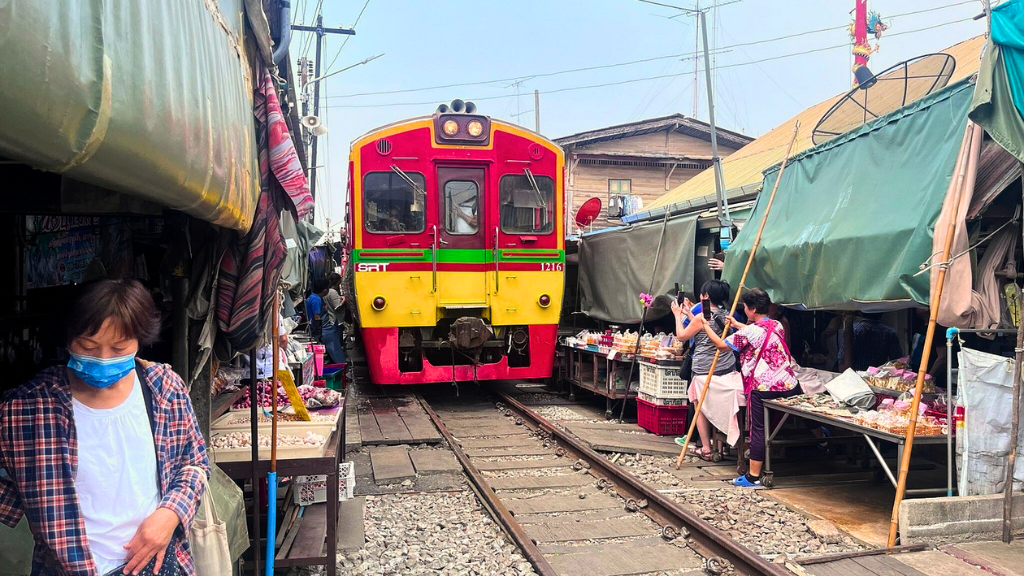
• Early Morning – Arrival at Damnoen Saduak Floating Market
Start your day early to experience the market at its most lively. Explore by boat or on foot, soak in the canal atmosphere, and enjoy local street food. Plan to spend around 1.5 to 2 hours here.
• Mid-Morning – Transfer to Maeklong Railway Market
Continue your journey to Maeklong Railway Market, located about 20 minutes away. The transfer is simple and can be arranged by tour, taxi, or Grab.
• Late Morning – Explore Maeklong Railway Market
Discover one of Thailand’s most fascinating markets, where a train runs directly through the center. Witness the unique moment when vendors quickly pull back their stalls as the train approaches, then resume business just seconds later.
• Around Midday – Return to Bangkok
Head back to Bangkok, typically arriving around midday, leaving plenty of time for lunch or further exploration in the afternoon.
FAQs
1. Is Damnoen Saduak Floating Market worth visiting, or is it too touristy?
Damnoen Saduak Floating Market is quite touristy, but still worth visiting if you set the right expectations. It offers a very iconic and photogenic canal-side experience that’s easy to reach from Bangkok. Go early in the morning to avoid crowds and see the market at its liveliest.
2. Can you visit Damnoen Saduak without taking a boat?
Yes, absolutely. The market is accessible on foot from the main road — a 10-minute walk or a 10–20 THB motorbike taxi ride from the bus stop. A boat tour is a paid optional extra, not a requirement.
3. Can I visit Damnoen Saduak independently, or is a guided tour recommended?
Yes, you can absolutely visit Damnoen Saduak Floating Market independently, and many travelers do. A guided tour is not required, but it depends on the kind of experience you want.
Damnoen Saduak Floating Market remains one of the most iconic floating markets near Bangkok, offering an authentic glimpse into traditional Thai canal life. Whether you visit independently or join a guided tour, the experience is memorable and easy to include in a half-day itinerary. For the best experience, it is recommended to arrive early in the morning to enjoy a more lively atmosphere and avoid the peak crowds.




 Google
 Facebook
 Tripadvisor
 Trustindex


