


In the mountains of northern Vietnam, the water filling season in Vietnam transforms terraced rice fields into vast natural mirrors. As water gradually fills the terraces before rice planting, the flooded fields reflect the sky, clouds and surrounding mountains, creating some of the most striking landscapes of the year.
But when does the water filling season begin, and where can you see the terraces at their most spectacular? From Hoang Su Phi and Mu Cang Chai to Sa Pa and Y Ty, this guide explores the best places to experience Vietnam’s flooded rice terraces, what to expect during the season and practical tips to help you plan your trip.
Table of Contents
What is the water filling season in Vietnam’s terraced rice fields
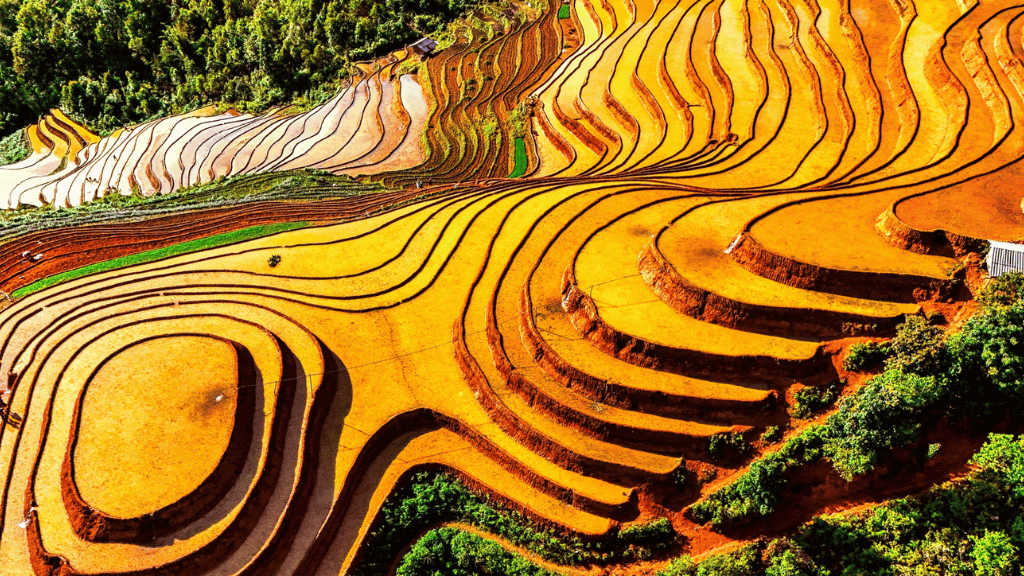
In Vietnam, the water filling season refers to the period when farmers begin channeling water into the rice terraces to prepare the land for cultivation. In the northern mountains, once the first rains have fallen, water from mountain springs and streams is guided down to the terraces, then gradually shared out between the different plots.
This stage marks the start of a new farming cycle. Once the plots are sufficiently irrigated, residents plow the soil and begin transplanting the young rice seedlings. For travelers, it is a particularly interesting time to observe traditional farming practices up close and to see something of rural community life, while the water filled terraces create the well known mirror landscapes across the northern mountains. In Mu Cang Chai, this period is even marked by local festivals celebrating the water filling season and the culture of the Hmong, Thai and Dao communities.
When to see Vietnam’s terraced rice fields during the water filling season
There is no single date that applies across the whole region. The water filling season depends on rainfall, altitude and the local farming calendar. Vietnam News, reporting from Lao Cai, notes that late April into May and even June is generally considered the most striking time to visit the northwest, when farmers pour water into the terraces in what is known locally as the water pouring or water filling season. Across the main northern destinations, the period broadly runs from April to June, with real differences from one area to the next.
| Destination | Period | Notes |
|---|---|---|
| Sa Pa | Late April to June | The water filling season starts as early as late April. Mid May to early June is especially good for seeing the flooded terraces, particularly in the Muong Hoa valley. |
| Mu Cang Chai, Hoang Su Phi, Y Ty | May to June | The water season shifts slightly depending on altitude and local conditions, with beautiful flooded terraces generally visible between May and early June. |
| Pu Luong | May to June, sometimes into July | Water filling usually happens in this window, though the exact timing can shift a little depending on rainfall and local farm work. |
Top places to admire Vietnam’s water-filled rice terraces
Northern Vietnam holds some of the most striking flooded terrace landscapes anywhere in the country. Each destination has its own character, whether that means dramatic relief, cultural immersion or easier access. The region spans the provinces of Son La, Dien Bien, Lai Chau and Lao Cai, offering immersive encounters with ethnic communities alongside sweeping mountain scenery.
Hoang Su Phi, the wildest and most dramatic terraces
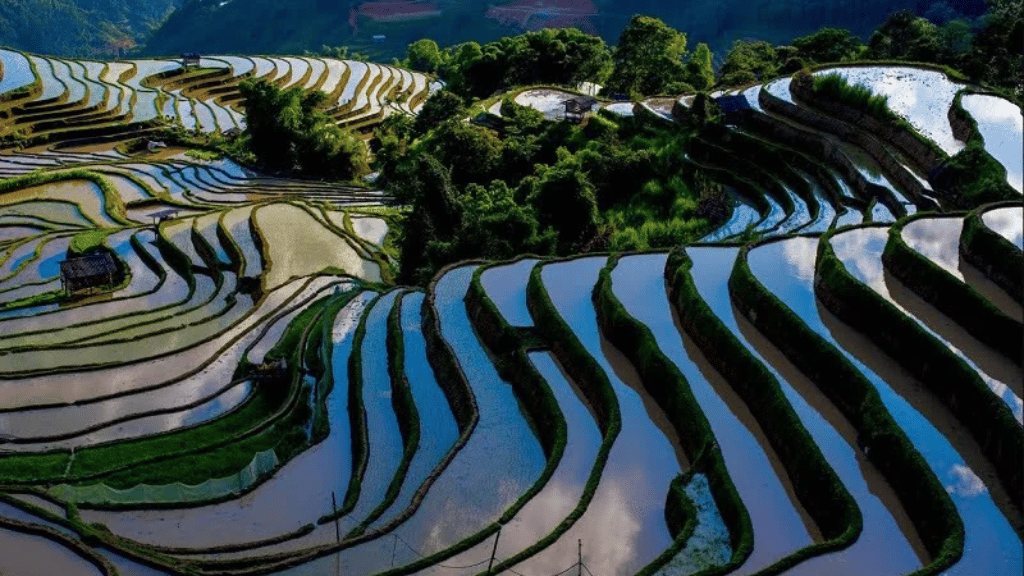
Set in the northern mountains, Hoang Su Phi appeals especially to travelers looking for landscapes that feel untouched and an atmosphere that is less crowded. Its terraces stretch across the mountainsides in sharply defined lines that give the relief a striking, almost graphic quality. Following the 2025 provincial merger, Hoang Su Phi now sits within the newly formed Tuyen Quang province.
The terraces are spread across several communes, including Ban Phung, Ban Luoc, San Sa Ho, Ho Thau, Nam Ty and Thong Nguyen, the result of centuries of work by local communities, largely the La Chi, Dao and Nung ethnic groups. During the water filling season, the difference in height between the plots sharpens the reflections and can create the impression of an enormous staircase covered in mirrors. For photography and trekking enthusiasts, Hoang Su Phi is one of the best places to experience northern Vietnam’s terraced rice fields away from the busiest routes, with the villages of Luoc, Phung, Nam Pien and Ong Thuong offering good vantage points.
Sa Pa, easy to reach and rich in ethnic diversity
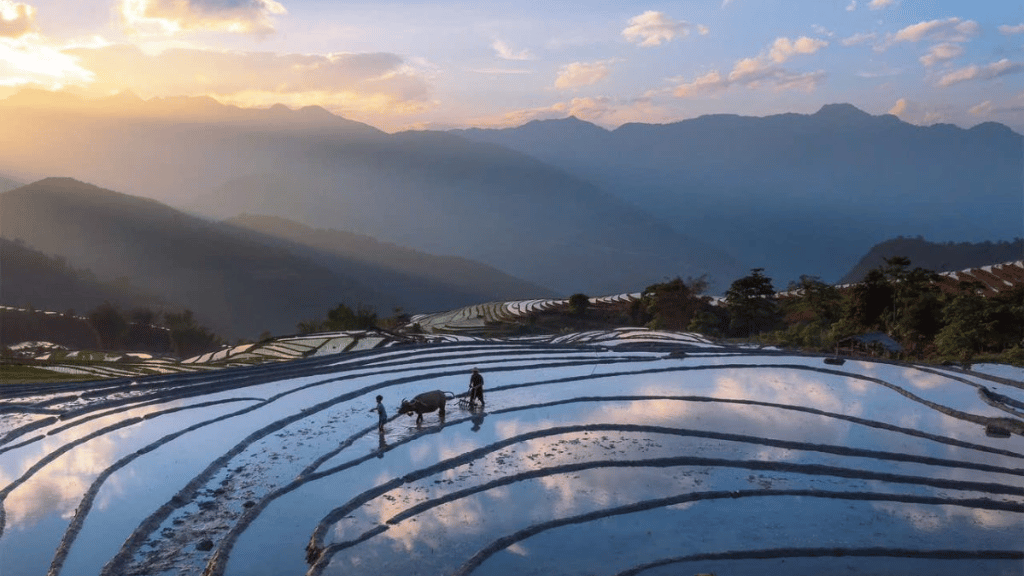
More accessible than some of the more remote parts of the north, Sa Pa is a good choice for a first encounter with Vietnam’s terraced rice fields. The Muong Hoa valley and the villages of Lao Chai, Ta Van and Hau Thao let you take in the terraces while also getting a look at daily life among the Hmong, Dao and Giay communities. The shimmering terraces of the Muong Hoa, Ta Van and Ta Phin valleys are especially striking as water flowing down from mountain streams floods the paddies, creating rippling waves that catch the sunlight.
These terraces, farmed for generations by Hmong, Dao and Tay communities, were voted among the world’s seven most magnificent terraced fields by readers of Travel + Leisure in 2009 and by the international tourism network Touropia in 2013.
During the water filling season, visitors can watch farmers plowing, channeling water and beginning to transplant the rice. Sa Pa therefore strikes a good balance between scenery, hiking and cultural discovery.
Pu Luong, gentle terraces and a peaceful atmosphere
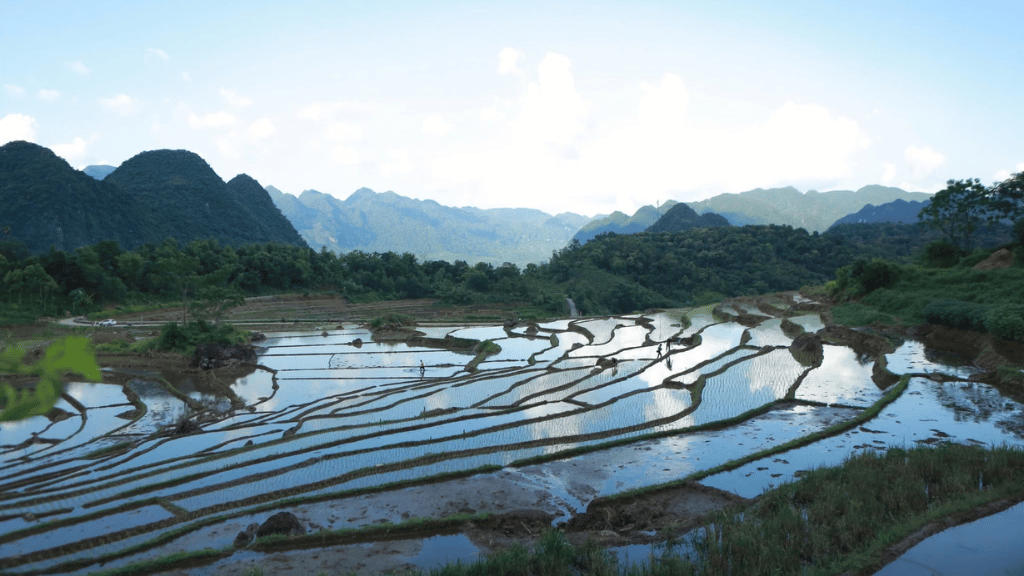
Pu Luong, in Thanh Hoa province, offers a different landscape from the high mountains of Hoang Su Phi or Mu Cang Chai. Its terraces are gentler and sit within valleys surrounded by forest, villages and limestone mountains.
Late May into early June tends to be when young rice gives the terraces their bright green color, while September and October bring the harvest. Pu Luong should not be presented as an exact equivalent of the mirror season found in Mu Cang Chai or Sa Pa.
Its appeal lies more in the peaceful atmosphere, the Thai villages, the stilt houses and the traditional irrigation systems, particularly the bamboo water wheels used to bring water up to the rice fields.
Mu Cang Chai, one of Vietnam’s most celebrated heritage sites
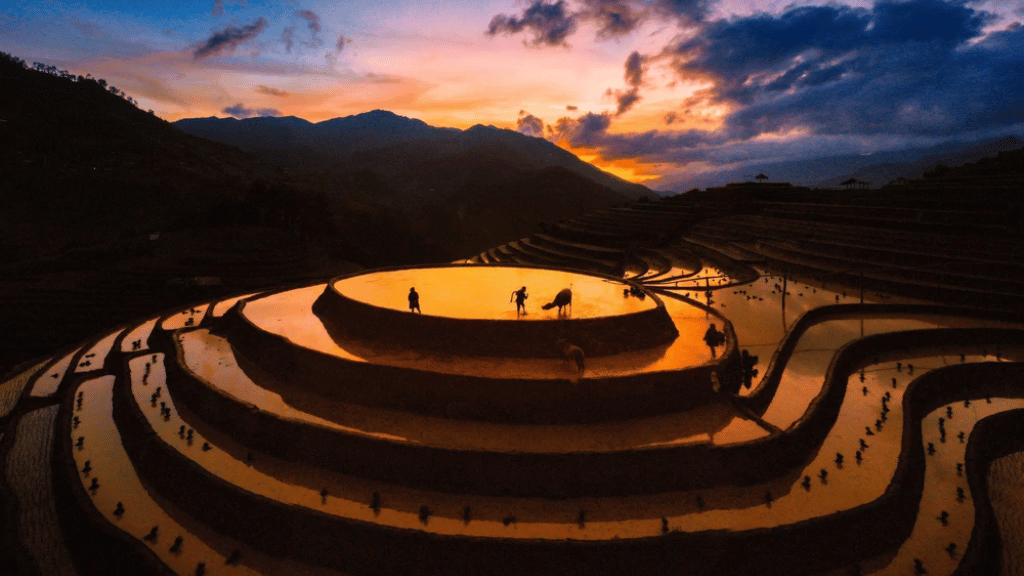
About 300 kilometers from Hanoi, Mu Cang Chai is one of Vietnam’s great terraced rice field landscapes. Following the 2025 provincial merger, the area now falls within the newly formed Lao Cai province. The terraces were first recognized as a national heritage landscape in 2007, before being elevated to Special National Heritage status in 2019, covering close to 872 hectares across several communes, including La Pan Tan, Che Cu Nha and De Xu Phinh.
Hmong communities make up the large majority of the local population and have shaped these mountains over generations to create terraces suited to rice farming. During the water filling season, the curves of the water filled plots create a striking contrast against the surrounding mountains, streams and pine forest.
Mam Xoi hill is a particularly well known viewpoint for taking in the shape of the terraces from above. Access can become difficult when the paths are wet, so a local driver can be a useful help in reaching some of the viewpoints.
Y Ty, off the beaten path, between clouds and mist
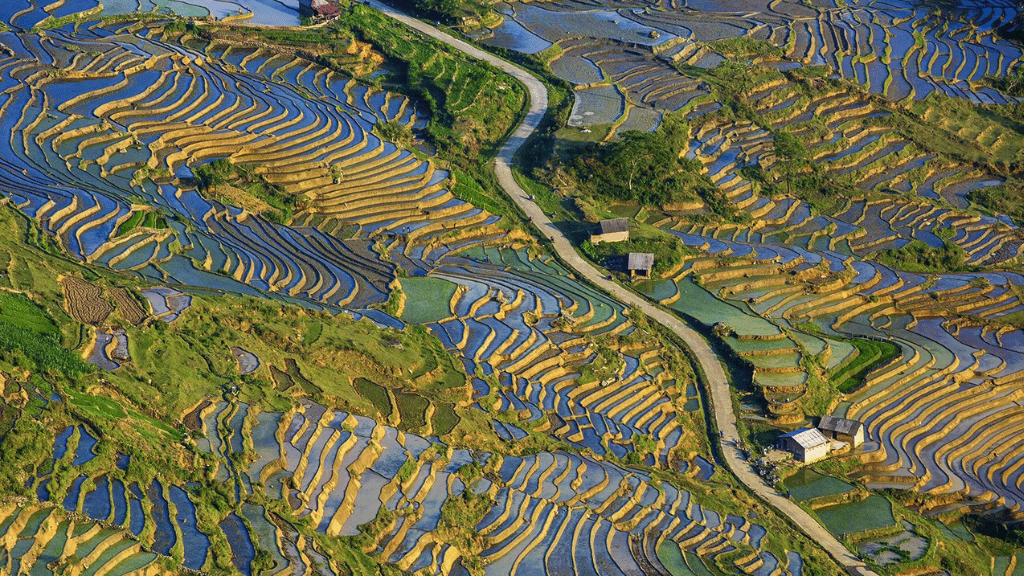
At over 2,000 meters above sea level, Y Ty offers a very different atmosphere from Sa Pa. It now also sits within the newly formed Lao Cai province. Known as the land of clouds, the region is defined by its mountain scenery, its mist and cloud effects and the presence of the Ha Nhi community, whose terraces resemble giant staircases rising toward the sky.
From May to June, the terraces gradually fill with water ahead of transplanting. The shimmering plots blend with mountains that are often wrapped in mist, alongside the community’s traditional rammed earth houses, creating a scene that photographers find especially rewarding. One particularly good spot for admiring the flooded terraces is Thien Sinh Bridge, at the edge of Lao Chai village, about 10 kilometers from the center of Y Ty commune, where clouds swirl above the peaks while the flooded terraces below reflect the sky.
Y Ty suits travelers who want to step away from the classic routes and combine landscape, local encounters and mountain immersion in one trip.
What to experience during this season
The water filling season is not just about admiring the scenery. It is also a good time to hike between the terraces, learn about farming traditions, meet residents and watch their daily work. Depending on the destination, travelers can also enjoy more original experiences, such as paragliding above Mu Cang Chai or hiking through the mountain villages.
Paragliding over the flooded terraces
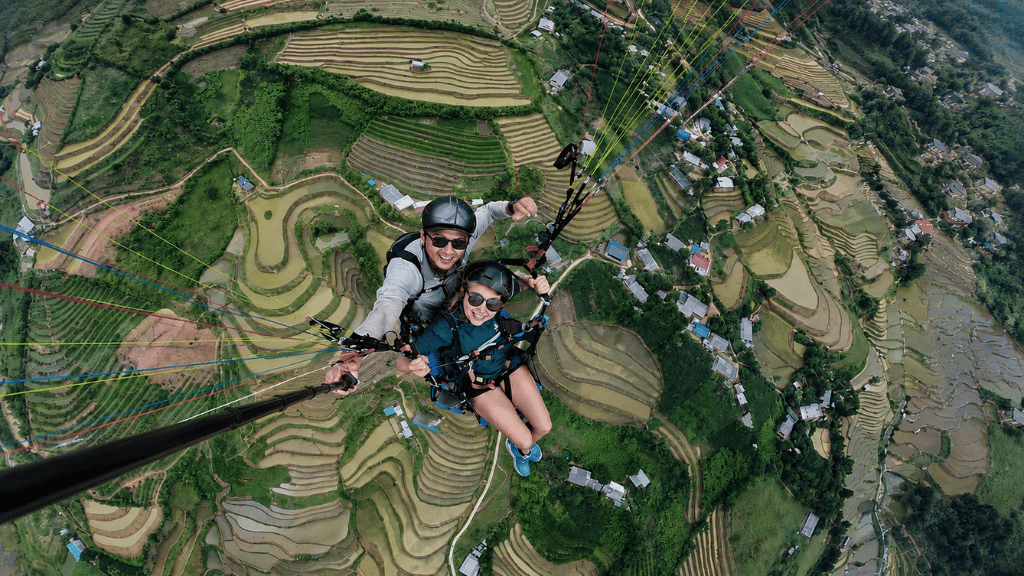
In Mu Cang Chai, some events held during the water filling season let travelers fly over the terraced rice fields by paraglider from Khau Pha Pass. From the air, the water filled terraces look like great mirrors set among the mountains, offering a sweeping view over the whole valley.
For those who would rather stay on the ground, villages such as Ta Van in Sa Pa also let you experience the season up close with local residents: walking between the terraces, watching the rice being transplanted and getting a feel for everyday life. These experiences add another dimension to the trip, letting you take in the scenery while learning about the traditions of the mountain communities.
Watching the terraces become natural mirrors
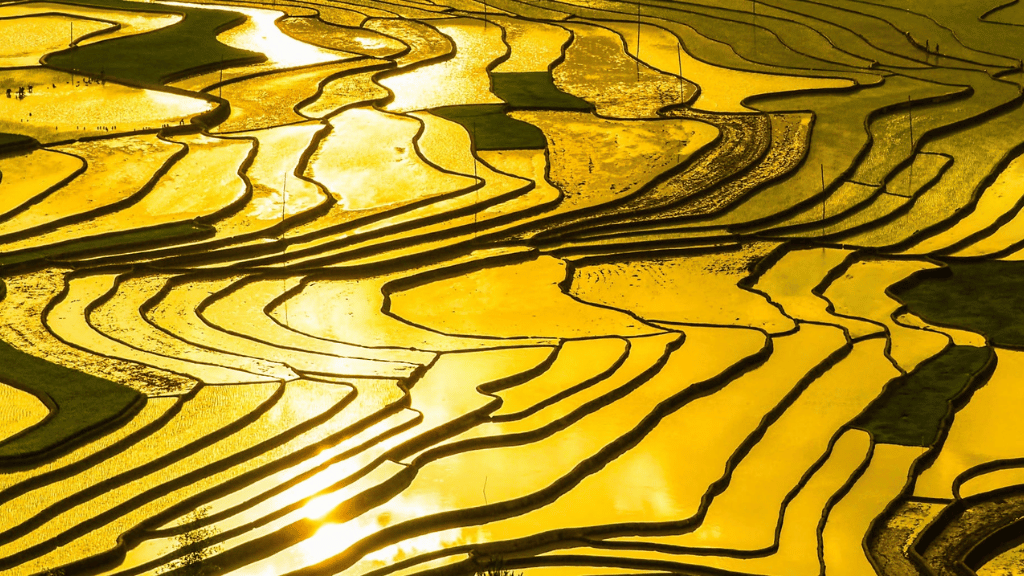
This is probably the most distinctive experience of the water filling season. During this period, the plots are gradually covered with a thin layer of water ahead of transplanting. The terraces then take on the appearance of large natural mirrors, reflecting the mountains, the clouds and the light of the sky. In Mu Cang Chai as in Sa Pa, this shift completely changes the landscape and reveals the terraces in a form quite different from the green or golden seasons.
Photographing the mountain reflections
The water filling season lets travelers see the landscapes of northern Vietnam from another angle. In Mu Cang Chai, Mam Xoi hill and Khau Pha Pass offer good viewpoints, while in Sa Pa, the Muong Hoa valley is well suited to both hiking and photography.
Sunrise or late afternoon are the best times, when soft light reflects off the terraces and brings out the shape of the land. It is also a pleasant time to slow down, walk between the plots and enjoy the quiet of the villages. Across northern Vietnam’s terraced rice fields, every change in light transforms the reflections and offers a different experience, particularly in Mu Cang Chai, Sa Pa or Y Ty.
Hiking between terraces and villages
Hiking lets you do more than admire the terraces from a viewpoint. It lets you walk directly through the farmed landscape. In Sa Pa, trails around the Muong Hoa valley pass between the terraces and several villages. In Hoang Su Phi, routes can likewise lead through terraces, forests and the villages of local communities.
Discovering farming traditions during the water filling season
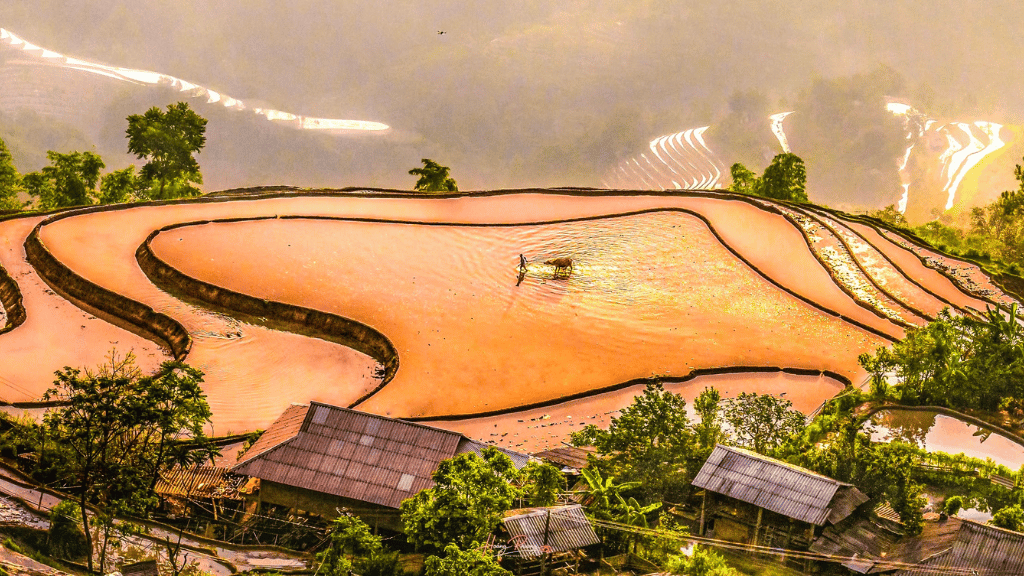
During the water filling season, farm life becomes especially visible across the mountains of northern Vietnam. Travelers can watch residents preparing the plots, plowing the fields, guiding water to the terraces and then transplanting the young rice seedlings. These practices, adapted to the mountainous terrain, are part of Vietnam’s traditional agriculture and are passed down from one generation to the next.
On a trip to Vietnam, it is sometimes possible, with a local family or guide, to take part in transplanting rice. Stepping into the mud, planting the young shoots and following the movements of local farmers gives a better sense of the work behind these terraces. This kind of experience offers a more genuine look at rural life, local tradition and rice growing culture, beyond simply photographing the scenery.
Exploring traditional irrigation systems
During the water filling season, farmers rely on mountain springs and streams to feed their plots. Water is guided through small channels, then passes gradually from one terrace to the next using the natural slope of the land. In Pu Luong, residents also use bamboo water wheels to lift water up toward the rice fields. This traditional technique allows rice to be grown while working with the mountainous terrain rather than against it.
Practical tips for your trip
- Prepare for changing weather. Bring a light waterproof jacket, sun protection and a waterproof bag to protect your belongings.
- Pack the right shoes. Choose non slip hiking shoes, since paths can turn muddy and slippery after rain.
- Consider a local guide. A guide makes it easier to reach villages and viewpoints while helping you understand the traditions and farm work you are seeing.
- Pick a region based on the scenery you want. Mu Cang Chai and Hoang Su Phi for dramatic terrain, Sa Pa for easy access and Y Ty for a more remote atmosphere.
- Plan for 2 to 3 days on site. This gives you enough time to see several villages and watch the terraces under different light.
- Choose accommodation within the villages. A homestay lets you enjoy the scenery from early morning and makes it easier to experience local life.
- Keep your itinerary flexible. Weather and mountain road conditions can change quickly during this season.
FAQs
1. When is the best time to see Vietnam’s water filling season?
The best time to see Vietnam’s flooded rice terraces is generally from May to June, during the water filling season in Vietnam. As farmers prepare the fields for planting, the terraces gradually fill with water, creating mirror-like surfaces that reflect the sky and surrounding mountains
2. Where can you see the best mirror-like rice terraces in Vietnam?
Mu Cang Chai stands out for its dramatic terraces, Sa Pa for the scenery of the Muong Hoa valley and its accessibility, while Hoang Su Phi offers a wilder, less visited landscape. The best choice depends on the kind of experience you are after.
3. Does Vietnam’s water filling season coincide with the rainy season?
Not exactly. The first rains provide part of the water needed for the crops, but farmers also rely on mountain springs and streams, which they guide toward the terraces through traditional irrigation systems. The water filling season depends mainly on the local farming calendar rather than rainfall alone.
4. What are the best times to photograph Vietnam’s flooded rice terraces?
The best times to photograph Vietnam’s flooded rice terraces are early morning and late afternoon, when the soft light enhances the reflections of the sky and mountains on the water. For the most striking landscapes, visit during the water filling season, usually from May to June, although the exact timing varies by region and altitude.
5. What do the rice terraces look like throughout the year?
The rice terraces change dramatically throughout the year. During the water filling season in May and June, the flooded fields create mirror-like reflections of the sky and mountains. In July and August, the terraces turn a vibrant green as the rice grows. From September to October, harvest season transforms the landscape into beautiful shades of golden yellow.
The water filling season in Vietnam is one of the most fascinating moments to discover the mountains of the north. For a few weeks, the terraced rice fields become shimmering mirrors, reflecting the sky and surrounding peaks while revealing the rhythm of rural life.
From the spectacular terraces of Hoang Su Phi and Mu Cang Chai to the valleys of Sa Pa, Y Ty and Pu Luong, each destination offers a different landscape and atmosphere. Beyond the photographs, travelling during this season means meeting local communities, discovering traditional farming practices and experiencing the mountains at their most authentic.
Ready to see Vietnam’s rice terraces transformed into giant mirrors? Let us help you plan a tailor-made journey around the water filling season, with the right destinations and timing for an unforgettable experience in northern Vietnam.




 Google
 Facebook
 Tripadvisor
 Trustindex


